Beyond the Betrayal: Decades After a Displacement, Seneca Nation Seeks A Voice in the Future of the Kinzua Dam
Part 2 Article for SN Newsletter. Pittsburgh Post Gazette. By Stephana Ocneanu
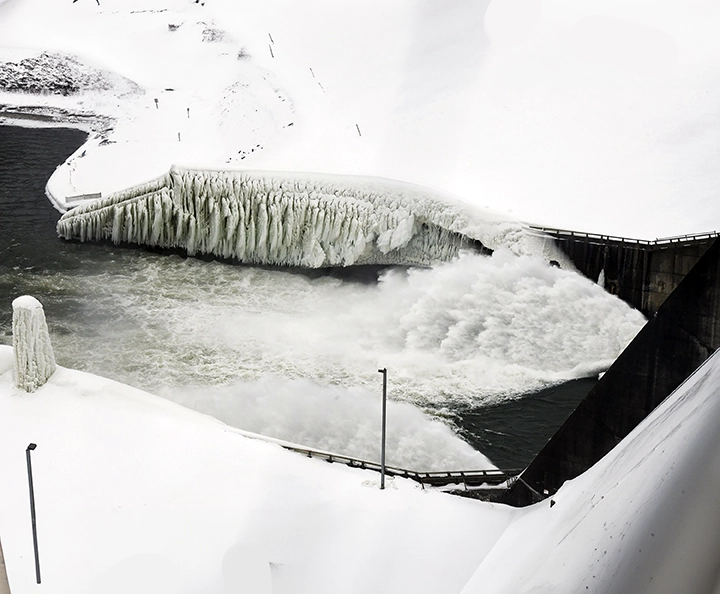
Pictured above: [Water is ejected from the Kinzua Dam on Wednesday, Feb. 11, 2026.(Giuseppe LoPiccolo/Post-Gazette)]
Among the lands flooded was the Cornplanter Tract — the last remaining piece of recognized tribal land in Pennsylvania, granted to Seneca Chief Cornplanter in the late 18th century. When the reservoir filled, that tract disappeared beneath the water.
Bruce Abrams was 17 when his family was forced out of the home that his father built in Red House, a community near the Allegheny River.
The home sat near woods that stretched to the riverbank. A place where Mr. Abrams bonded with his father over trapping, fishing and hunting. There were many nights he would watch his father build a fire along the riverbank, sitting and watching the river flow.
“That gave him the most sense of peace,” he said. “I think that’s what most Seneca men did. Things were a lot simpler then, and I think that’s the way they wanted it to be. They didn’t want to be bothered.”
By April 1965, Mr. Abrams and his family moved into replacement housing in Jimerson Town, located in Cattaraugus County southwest of Buffalo, N.Y.
Houses were packed tightly together while members were distanced from the river. Mr. Abrams’ father never hunted, fished or trapped again.
“It was nothing like it was before, and it didn’t really seem like home,” he said. “It seemed like a place we were sent to or just put there.”
Not long after the relocation, Mr. Abrams was drafted into the Vietnam War.
“On one hand, they take stuff from you, and then they come back a year later and say, ‘Oh, you’re coming here, you’re going to do this for us,’” he said.
Mr. Abrams became a member of a surveyor’s union after he was discharged from service, and he later performed land surveys for the Seneca Nation. He reviewed maps of the land that was flooded, bringing up memories from the past.
“I knew where everybody lived, I knew them by name, and at the time I would know them by sight,” he said.

Mr. Abrams said that when he was a teenager, he didn’t understand the full extent of what was happening to his community or the lasting impacts it would leave — especially on the elders.
“We lost over 100 people in the next two years after the dam,” Councillor John said.
His grandmother died before the dam was finished. Officials called it a heart attack.
“But to those of us that knew the elders, it was a broken heart,” he said.
Families were forced to exhume hundreds of graves before the reservoir filled. Councillor John recalled identifying his own grandfather’s remains.
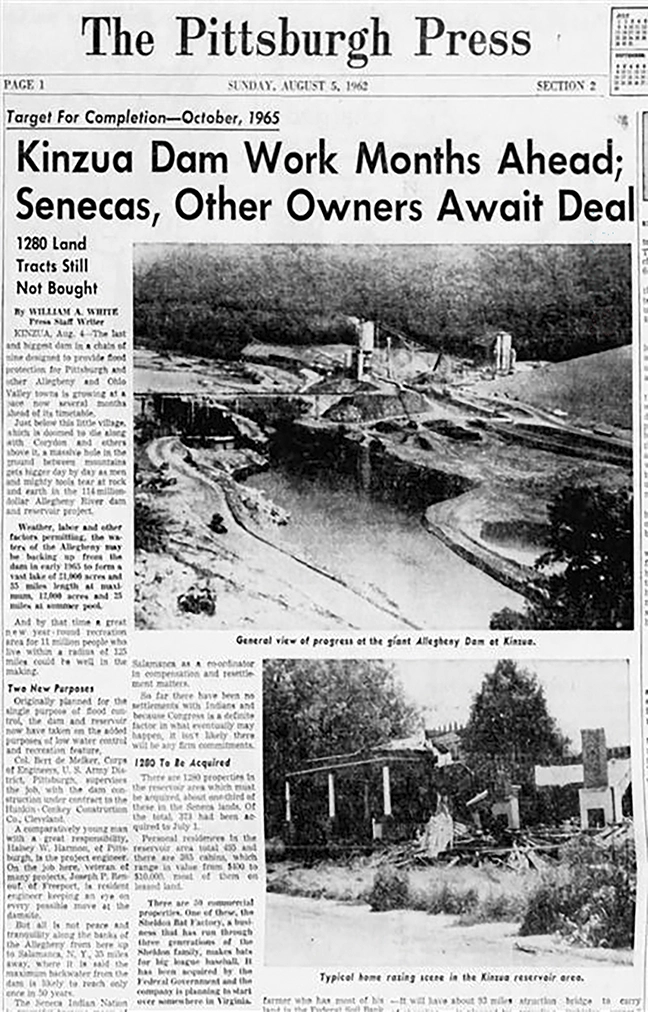
“How long would it take you to get rid of that trauma?” he said.
The ‘best form of restitution’
Native nations across the U.S. have endured land — and life — upheaval similar to Seneca.
At least 1.13 million acres of tribal land have been flooded under the reservoirs of 424 dams, according to a 2023 research study by Heather Randell and Andrew Curley, published in the peer-reviewed Environmental Research Letters journal.
On average, each dam flooded approximately 8,232 acres of reservation land, with the Oahe Dam on the Missouri River in South Dakota flooding the most total tribal land at 160,414 acres, according to the study.
Ms. Randell told the Post-Gazette that dams also submerged an average of 3% of a reservation’s land under their reservoirs. The Kinzua Dam flooded nearly one-third of the Allegany Reservation. She argued that for Native nations who lost their land, dam removal is “the best form of restitution.”
More than 100 dams were removed in the U.S. in 2024, according to data from the American Rivers, a Washington, D.C.-based nonprofit. At least nine were removed in Western Pennsylvania, including the Monongahela River Locks and Dam 3 in Elizabeth.
Several hundred more across the U.S. were removed in the years prior as a part of a growing movement to restore river ecosystems, eliminate safety risks for surrounding communities and save taxpayer money by avoiding costly maintenance upgrades or restoration projects.
But for dams that provide essential benefits that are difficult to replace, like flood control, removal is not typically an option.
Kinzua, in particular, has prevented flood damages in the region that could’ve cost more than $1.2 billion, according to the Army Corps, by preventing too much water from flowing downstream too quickly.
Other benefits from the project include releasing water during dry spells through its reservoir and generating hydroelectric power.
When removal isn’t on the table, alternatives typically include changes to dam operations, rehabilitation or repair, or modifications to add or improve fish passage, according to a 2024 federal report on dam removal.
Keeping History Alive
More than 100 miles northeast of Pittsburgh, the Kinzua Dam still stands tall in Warren County.
From a public overlook, tourists can lean over the metal railings to get a good look at the sweeping reservoir.
Faded signs at the site say the dam is 1,877 feet wide, and its reservoir stretches 24 miles.
Posters stapled to a board outside the walkway detail recreational activities, statistics and information, and a map of the Allegheny National Forest region.
Except for a few sentences about Seneca members living nearby, there’s nary a mention at the site of the project’s impact on the nation.
Councillor John said he fears the story will be forgotten.
“When we lose people, when they move off territory, they’re still Senecas. They should know our history, but it’s not in any history books, and it’s not out here,” he said. “All we try to do is keep our history alive, so that it’s not all for nothing.”
Congress ultimately awarded Seneca Nation $15 million in 1967 for relocation and rehabilitation, according to reporting done by The Pittsburgh Press at the time. The funds were used to build new homes and community buildings and to establish an educational scholarship fund. Some individual claims were also settled.
“It’s not about money for me,” Councillor John said. “That doesn’t last forever.”
“That can’t buy what we lost and what we’re about to lose.”
“When we lose people, when they move off territory, they’re still Senecas. They should know our history, but it’s not in any history books, and it’s not out here.”—Maurice “Moe” John, Councillor in Seneca Nation
With removal unlikely, the next chapter for the Kinzua Dam will be shaped by the Army Corps’ upcoming safety modification study.
“We are committed to a process where the Nation’s input is not just incorporated, but is a key component of our decision-making from start to finish,” Col. Melin said. “We will ensure that all of the Seneca Nation’s requests and objectives are clearly communicated, understood and given full consideration as the study progresses.”
Regardless of the Army Corps’ word, Councillor John does not intend to break his promise to his father.
The Seneca voice will be heard.
“This is a once-in-three-generation, 60-years event, and we may never get another say about it again,” he said.
“There’s so much that Senecas can add to history instead of just getting our footprint erased.”