Maple Syrup As Food Sovereignty
[Repost from Buffalo Spree By Lauren Newkirk Maynard; Photos by Tribe Up North, Lydia Gallagher Mar 2, 2026]
Springtime maple production is underway.
Skirting the Cattaraugus Indian Territory in southern Erie County, the hamlet of Taylor Hollow is home to Gakwi:y:oh Farms—pronounced GAK-wee-oh—a fifty-acre, Native American farm run by the Seneca Nation. This time of year, it hums with maple production, a vital part of Gakwi:y:oh Farms’ commitment to the Indigenous cultural and economic heritage of the Seneca, one of the six tribes of the Haudenosaunee Confederacy.
“Our mission is to help our people reclaim our agricultural roots and develop true food sovereignty,” says Levi Thomas, the farm’s interim director. Since U.S. tribes were forced to live on territories, farm-based livelihoods faded, leading to health and social issues borne of dependence on non-native foods, lack of Indigenous-run businesses, and multi-generational loss of native farming practices.
The maple tree, or Wáhda’ in Seneca, can help bridge that knowledge gap, says Thomas. Central to Seneca cultural and spiritual life, the maple is considered the leader of all trees and a medicinal gift from the creator. Its sap is a sign of renewal and a nutritious food source during lean months; the tree is mentioned in Seneca ceremonies throughout the year.
Levi Thomas is the interim director of Gakwi:y:oh Farms.
“We like to take a shot of the free-flowing sap as a way to detox,” Thomas adds. “It breaks up the long, cold winter and gives thanks for spring.”

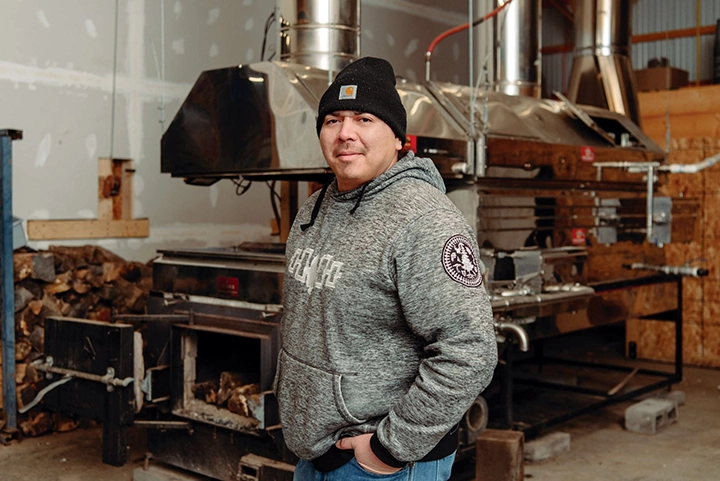
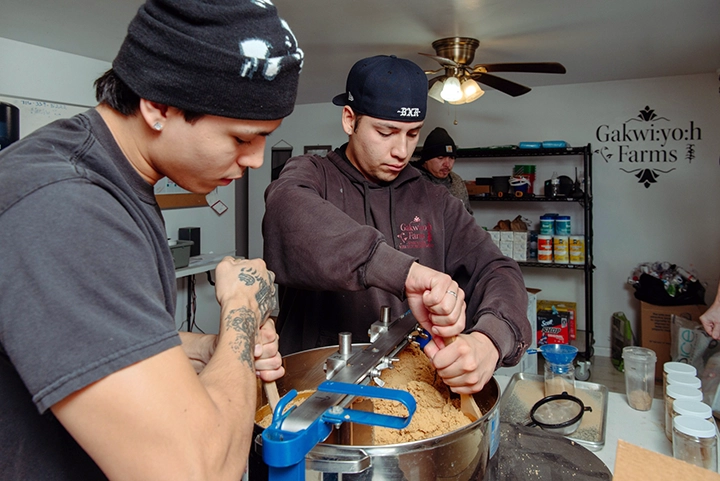
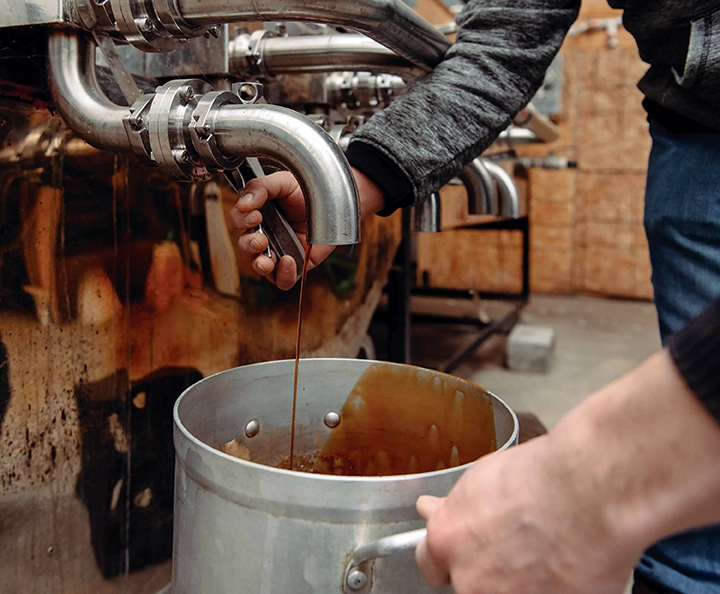
In late February and early March, Gakwi:y:oh Farms taps 4,000 maple trees on two properties, a friend’s nearby farm and another property on the Salamanca Territory. Native Americans used to bore holes into the trees with a sharp piece of bone, and sap would run down tree-bark funnels for collection. Today, maple groves are a maze of blue gravity-fed tubing that directs sap into plastic buckets and large holding tanks before it’s transported to evaporators at the Taylor Hollow farmstead.
Evaporated sap is bottled as the various grades of pure syrup, maple sugar, and maple cream sold at local farmers markets, casinos, and community gatherings throughout the Southern Tier.
Established in 2018, Gakwi:y:oh Farms partners with neighboring growers and organizations like the USDA, Seneca Nation’s Department of Agriculture, and Cornell University to grow an expanding roster of traditional Haudenosaunee crops, like the famous Iroquois white corn and “the three sisters”—corn, beans, and squash. It also offers u-pick berries, a newly planted apple orchard, native pawpaw trees, tomatoes, cucumbers, honey, and other conventional produce. A thirty-three-head off-site bison farm provides local quality meat while honoring an animal with deep ties to Indigenous life.
Combining traditional and modern growing methods, Gakwi:y:oh composts with horse and bison manure, weeds by hand, and uses other gentle farming techniques to promote soil health and biodiversity, practices their ancestors perfected generations ago. “We try to follow natural growing and harvest timelines, like the monthly moon phases,” Thomas says.
As part of the farm’s mission to retain traditional knowledge and support native agriculture, Thomas and other employees give presentations at schools to educate people about the importance of Indigenous foods. The farm’s maple syrup is a popular lesson.
Last fall, for example, elementary students met with Thomas and sampled the syrup, which they agreed tasted different—and better—than store-bought. In the summer, local youth volunteer to help with the farm’s weeding and harvesting.
Indigenous recipes are given to kids and adults, says Thomas, and maple products are delivered to elders across the region through food distribution programs, Native-owned markets, and One-Stop gas stations. Thomas also plans to partner with local restaurants and hopes to increase the availability of maple products on store shelves.
“The ultimate goal is to make our native community self-sustainable,” he says.
Visitors are welcome at the farm, and tours are available for groups or individuals; call ahead. If you’d like to sample the syrup, white corn pancakes, and bison sausage; details about the farm’s annual breakfast can be found on its social media channels and at SNI.org. Not only will your stomach thank you, but Gakwi:y:oh Farms and its maple trees will extend gratitude, or Nya:wëh, for supporting an ancient and naturally rooted way of life.
Gakwi:y:oh Farms – 13594 Taylor Hollow Road, Collins, NY.
sni.org/community-services/gakwiyoh-farms
Photos By Tribe Up North, Lydia Gallagher