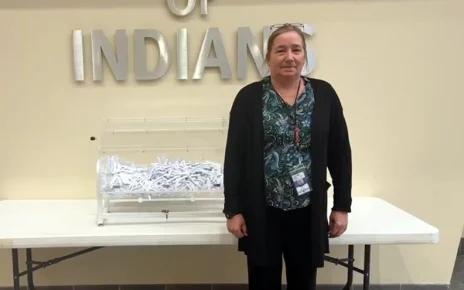
Wednesday, March 25th | By Sam Laskaris, Local Journalism Initiative Reporter | Windspeaker.com
The Haudenosaunee Nationals Lacrosse Organization is still pressing for its women’s and men’s clubs to be allowed to participate at the 2028 Summer Olympics in Los Angeles. Lacrosse hasn’t been part of the Games since 1908. Back then it was field lacrosse that was played. In 2028 it will be Sixes lacrosse, six players per team on the field.
Claudia Jimerson, the Haudenosaunee Nationals’ director of lacrosse operations, stressed what’s at stake goes far beyond competing in the next Olympics.
Jimerson provided an update on the program’s plight during a session March 23 at the Reservation Economic Summit held at Caesars Palace in Las Vegas. The four-day conference has attracted more than 5,000 delegates, primarily from the United States and Canada.
“The 2028 Summer Olympics represents a once-in-a-generation opportunity, not just for the Haudenosaunee but for the game itself and for Indigenous people around the world,” Jimerson said.
Indigenous people invented the sport of lacrosse, which they also call the Creator’s Game, and Indigenous teams have registered superb results at international competitions over the years.
The governing body of the Los Angeles Olympics, the International Olympic Committee (IOC), has said it will not allow the Haudenosaunee to participate under its own flag. An IOC eligibility rule states that countries can only participate if they have a National Olympic Committee. The Haudenosaunee Nationals do not have such a committee.
But they have been allowed to compete in various international tournaments, including world championships, over the years as those are sanctioned by World Lacrosse, which permits Haudenosaunee participation.
Members of the Haudenosaunee Nationals prefer to travel on their own passports issued by the Six Nations Haudenosaunee Confederacy, but many countries do not recognize the Haudenosaunee passports.
“The Haudenosaunee Confederacy means every real definition of nationhood,” Jimerson said. “We have governance, treaties, identity, land and international participation. But because we do not fit neatly into that imposed framework, we are excluded.
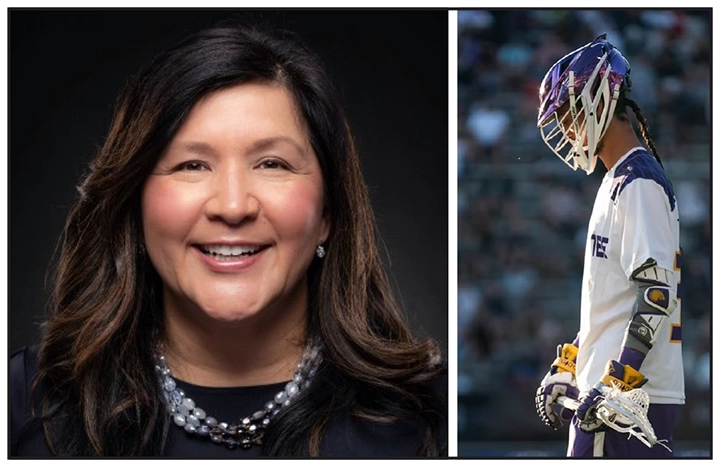
“This is about (whether) Indigenous sovereignty is or is not recognized by the global system. And that’s why this moment matters, not just for us but for every Indigenous Nation navigating the same systems. The barrier is structural, not athletic.”
Jimerson is hoping IOC officials will have a change of heart and allow the Haudenosaunee to take part in Los Angeles.
“It’s a game that’s been played for centuries for healing and unity and now it’s being seen by the entire world,” Jimerson said. “This opportunity is so important because it’s not just about lacrosse and the Olympics. It’s about whether the world will recognize the people who gave it life.”
Haudenosaunee Nationals’ representatives have been pleading their case to the IOC for some time.
“We’ve been told there are other variables involved,” Jimerson said. “The biggest thing is that recognizing the Haudenosaunee would encourage other groups to seek Olympic recognition. They think we’re going to open up this whole can of worms. Our counter argument is the Haudenosaunee case is unique because it meets a combination of factors,” which includes the fact that Indigenous people invented the sport.
“We are relevant in the international body,” Jimerson added. “World Lacrosse already recognizes the Haudenosaunee as a full member nation competing internationally.”
Jimerson and other officials of the Haudenosaunee Nationals, however, realize they have to carefully monitor their actions.
“When we talk about sovereignty in this context, we have to be thoughtful on how we frame it,” she said. “The IOC has made it clear that participation in the Olympic Games should not be used as a pathway or a strategy to establish international sovereignty.”
Jimerson said that thought is indeed respected.
“We’re not approaching this in a political maneuver,” she said. “We’re not positioning this as a way to force recognition within global systems. We’re being very intentional with our language, our messaging and how we show up in these conversations.
“Our approach is grounded. We’re not trying to argue our way into recognition. We are allowing the world to see us, to witness who we are, to understand where this game comes from, to recognize that we have always been here.”
Jimerson believes, however, “international recognition will strengthen the visibility of all Indigenous Nations. When one Indigenous Nation is seen on the global stage like the 2028 Summer Olympics, it shifts perception for all of us.
“It reminds the world that we are not just part of history. We are present, thriving and leading. That kind of visibility doesn’t stay contained. It expands outward, reflects on every Indigenous Nation.”
Jimerson also believes IOC recognition for the Haudenosaunee Nationals lacrosse program will have numerous spinoff effects.
“This is not just about one team,” she said. “This creates a pathway for Indigenous athletes to be seen, supported and compensated in ways that have historically not been accessible to us.”
And there’s also another important factor at stake.
“This allows us to build economic models that are rooted in our values, not told to us from the outside,” Jimerson added. “When people see Haudenosaunee on the world stage, they want to understand who we are, where we come from, what the Creator’s Game truly represents.
“That creates opportunities for cultural tourism and educational exchanges. It just doesn’t benefit us. It creates a broader interest in Indigenous cultures across Turtle Island.”
The Haudenosaunee Nationals are hoping to have some clear answers soon. In order to compete in Los Angeles, clubs have to qualify through continental championships, which will begin late this year.