By Patrick Monahan – University of Pittsburgh PittWire | Photography by Tom Altany | April 21, 2026
Submitted by Pamela Gifford
Growing up, Eli Hall’s family often visited the Allegheny Reservoir, a man-made lake that straddles the border between Pennsylvania and New York. Driving north along the shores, they’d see blue waters, boaters, swimmers, everything you’d expect from a summer lakeshore. But following that road into the Seneca Nation of Indians’ Allegheny Reservation, they’d see the reservoir change. Gone were the boaters and swimmers and gone were the blue waters. In their place was a mess of green algae.
But why?
Having just earned his PhD from the University of Pittsburgh, Hall finally has his answer. Along with it, he found a calling to use science to help people.
“As far as I know, I’m the first one in my family from both sides that has gone to grad school,” Hall said. “I never would have thought any of this would be possible.”
But Hall’s work on the question extends before his time at Pitt — and the problem’s origins go back much farther than Hall’s childhood. The Allegheny Reservoir was created when the Army Corps of Engineers completed the Kinzua Dam in 1965 as a means of controlling downriver floods in Pittsburgh. The resulting body of water took up close to a third of the reservation’s land, displacing around 600 Seneca by eminent domain and violating what was then the oldest treaty between the U.S. and a Native nation or tribe.
Hall, a Seneca himself, grew up nearby and often spent time in the reservation. As a college student at Rochester Institute of Technology, he decided to research the dam’s origins as a project for an environment and society class as Seneca elders seemed reluctant to discuss it.
“It’s still fresh on the memory for us,” Hall said. “I got more and more into it and decided to try to apply scientific principles such as remote sensing and biogeochemistry to give further context to the issue.”
He went on to work for the Seneca Nation Environmental Protection Department and then headed to Pitt for his PhD, where he joined the lab of Kenneth P. Dietrich School of Arts and Sciences Professor Emily Elliott as well as the Pittsburgh Water Collaboratory.
Hall’s thesis work started with a historical accounting of the reservoir, analyzing satellite imagery with machine learning to show that algae blooms in the northern portion of the reservoir happened annually going back to at least 1984: almost 30 years earlier than the available records claimed. Two different kinds of algae are responsible for the blooms, and in some parts of the reservation, he found, those blooms are getting worse.
But when he was finally ready to start the sampling that would comprise the core of his thesis, the work was delayed for two years by the start of the COVID-19 pandemic. It was the first of several times Hall would learn what he says is the most important lesson of his academic career so far.
“You’re going to get to a point where things just aren’t going right,” Hall said. “The most important thing is figuring out how to overcome the obstacles that are in your way. Every single obstacle you get past, the next one will get a little easier.”
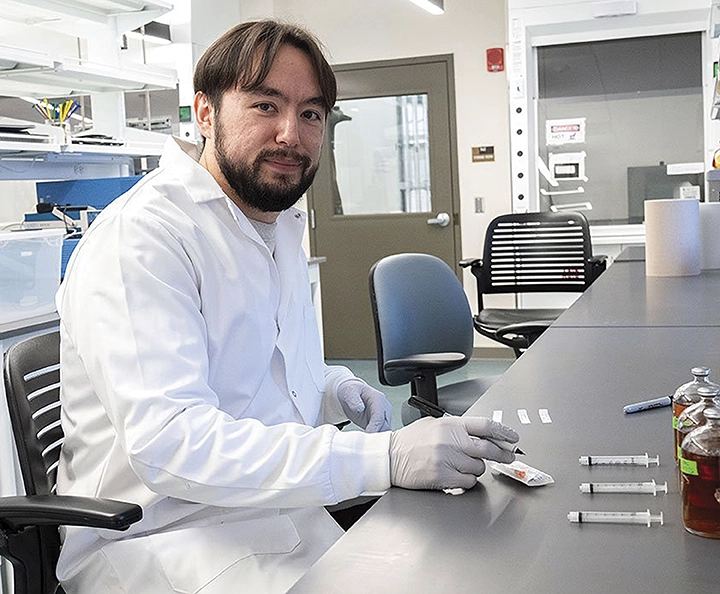
In 2022, Hall was able to get back in the field. In collaboration with scientists in the Seneca Nation and the Army Corps of Engineers, Hall collected several years of water samples from different parts of the lake.
The team’s goal was to track nitrogen, a nutrient necessary for the growth of algae that can make its way into water from wastewater, agricultural runoffs, rain or other sources. Each source leaves behind a characteristic ratio of isotopes, and so, with their data, Hall and his colleagues could identify the nitrogen sources fueling those blooms.
The main culprit: wastewater, which the team found was responsible for more than 70% of the nitrogen found in the reservoir. Whether due to power outages or heavy rainfall, treatment plants can sometimes dump untreated wastewater into the surrounding water bodies. Soil and fertilizer also contributed smaller amounts to the blooms. Identifying these sources, Hall said, will help those affected reduce the occurrence of the blooms by tackling the problem at its source.
And completing a project with so many distinct approaches means Hall is leaving Pitt with a far broader expertise than when he entered.
“Truth be told, I didn’t think I would do all three projects,” he said. “I’m glad I got the opportunity to because I’ve learned quite a lot about three very different disciplines.”
The questions he answered with those methods have implications that extend far beyond the border of the Allegheny Reservoir: Algae blooms cause $2 billion in economic damage each year in the U.S. alone, Hall said, as a result of declines in recreation value, challenges in processing water for drinking and other factors.
The project also confirmed for Hall that he wants his career to use scientific techniques to answer questions that have real, direct consequences for people’s well-being — what he calls a “community scientist.” For now, he’s looking for postdoctoral positions and figuring out where he’ll land. Wherever it is, he’ll be using his scientific skills to solve problems with real relevance.
“I want to do the science, and I want to help people,” he said. “If that’s academia, if that’s the federal government, that’s tribal governments, absolutely.”