March 18, 2026 | By George Payne | Repost from buffalorising.com
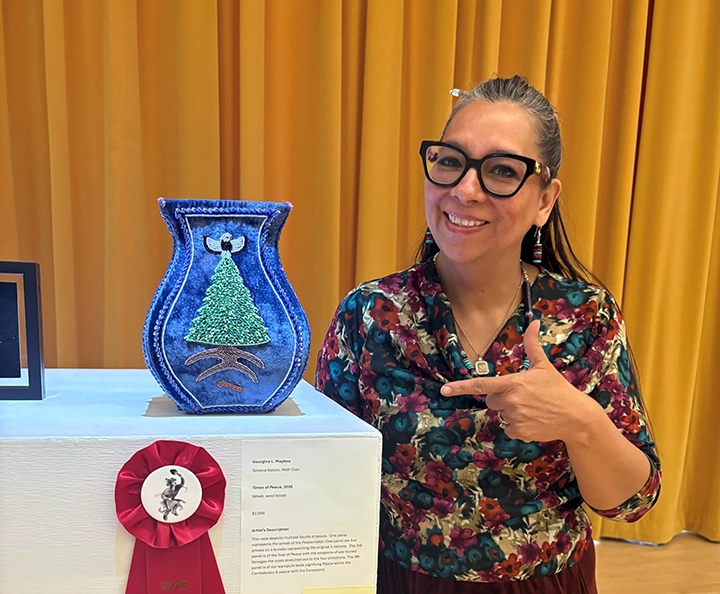
Pictured above: Gina Maybee, Seneca, Wolf Clan
For the first time in its history, the Ganondagan State Historic Site’s annual Haudenosaunee Art Show carries a unifying theme: “What is a Haudenosaunee Peace?” Kristin Asche, the lead curator of the 8th annual exhibition, sees this theme as both a lens for reflection and a challenge for artists.

Kristin Asche, Onödowa’ga:’ (Seneca), Wolf Clan (pictured left), was raised in Buffalo, NY, with roots in the Cattaraugus Territory of the Seneca Nation. Asche is an Interpretive Programs Assistant at Ganondagan, bringing a diverse background in client relations, cultural engagement, and arts administration, reflecting a deep commitment to community connection and service. Asche holds a Bachelor of Fine Arts in Photography with a minor in Museum Studies from Rochester Institute of Technology and previously served as assistant curator for the Wampum / Otgoä exhibition. Within the museum and art gallery sector, Asche has contributed to cultural heritage preservation through roles at Ganondagan and the Iroquois White Corn Project, where she also held park and recreation aide responsibilities. Beyond curatorial work, Kristin leads cultural workshops such as cornhusk doll making and gives presentations on topics including Haudenosaunee governance.
From Wednesday – Saturday | April 8 – 11, the juried Hodinöhsö:ni’ Art Show was held at the Seneca Art & Culture Center, just outside Rochester.
“This is the first time we have had a theme,” Asche explains. “In 2026, we mark the 250-year anniversary of the Revolutionary War. This is a big moment to reflect, and we wanted to use it to think about this marker — not only historically but through the lens of Haudenosaunee experiences.”
Asche emphasizes that the exhibition aims to move beyond focusing solely on historical suffering. “Our people have already faced devastation — the Seven Years’ War, the Sullivan-Clinton invasion. Our Confederacy was split. Some nations sided with the British, others with the Americans. It was a war between brothers. Amid that, we tried to remain neutral. The impacts of land loss, resource scarcity, and mass starvation shaped cultural teachings that still affect us today.”
The theme invites artists to grapple with these complex histories while reflecting on the resilience and continuity of Haudenosaunee culture. Central to this conversation is the Two Row Wampum Treaty, a metaphor for coexistence: one path for Native peoples in their canoe, another for European settlers in their ship, parallel lines that never cross. “It’s about balance,” Asche says. “We have to live with one foot in the canoe and the other in the world around us.”
The juried show, now approaching a decade, has become a platform for showcasing diverse Haudenosaunee artistry. “It’s important to show our artists producing all kinds of work, across styles and divisions,” Asche notes. “It challenges our communities to keep creating, to raise the bar, and to inspire one another. Native people are still here, and this is how we express that presence.”
As an artist herself, Asche draws inspiration from the work she curates. She has been learning finger weaving, a craft with deep roots in Haudenosaunee communities. “Seeing the skill, color choices, and techniques in this year’s submissions is incredibly inspiring. It motivates all of us to create bigger, more ambitious pieces.”
The exhibition also offered visitors an opportunity to engage with Haudenosaunee traditions, even if they are unfamiliar with them. “I hope people leave understanding that these are living teachings,” Asche says. “From the creation story to the 1794 Canandaigua Treaty, these stories are ongoing. The art shows that we are still creating, still maintaining our treaties, still living our teachings.”
Among the artists, Katsitsionni Fox stands out with her contemporary interpretation of traditional pottery. Her work Follow the White Roots references the Peacemaker story and the symbolic burial of weapons, prompting audiences to reflect on peace in their own lives. “It’s not just about history — it’s about how these lessons resonate today,” Asche emphasizes. “The metaphor of trying to break one arrow versus many — that we are stronger together — is universal. Divisiveness doesn’t serve us. This is a lesson for everyone.”
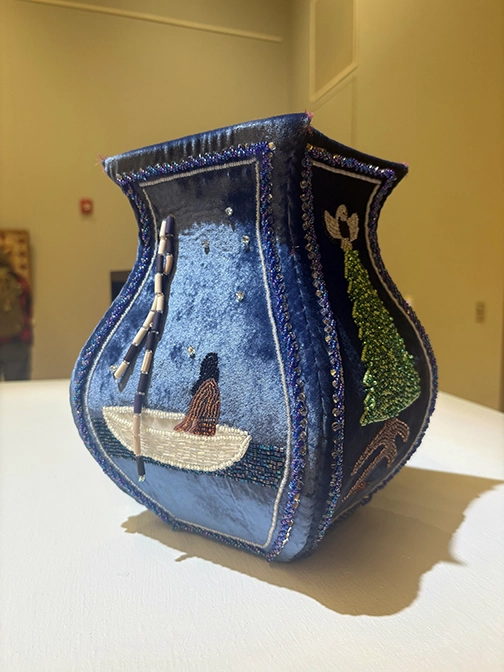
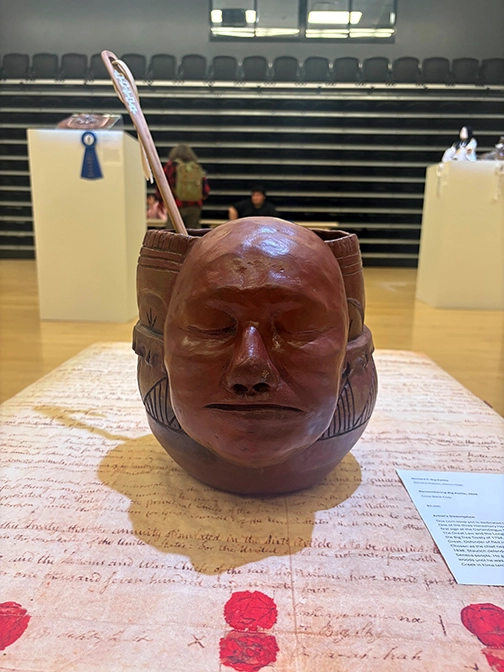
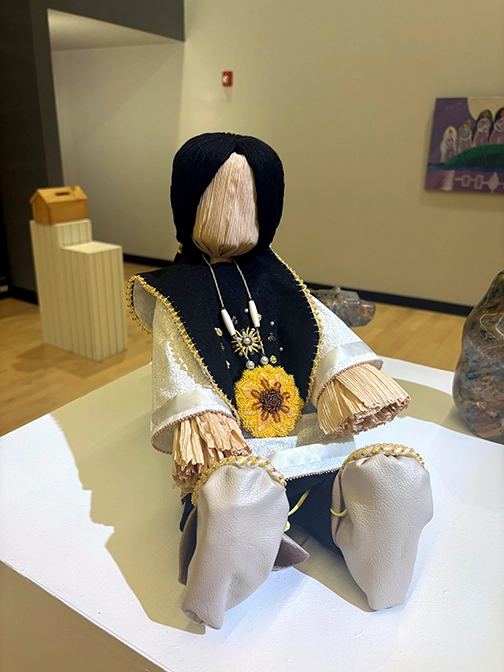
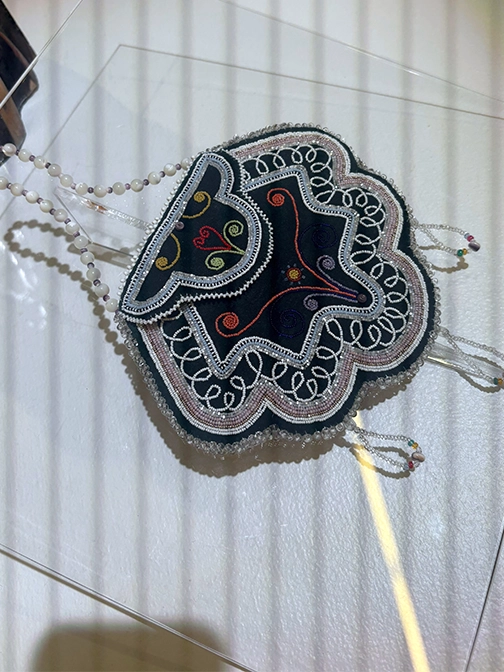
The 2026 exhibition, featuring 32 artists, is distinct not only for its theme but also for its resonance with ongoing Haudenosaunee life and sovereignty. Asche reflects, “Our oral traditions, our metaphors, our teachings — they are alive. Long ago does not mean irrelevant. Through this exhibition, visitors see that Haudenosaunee culture is not a relic — it is a living, breathing presence that continues to inspire, educate, and challenge.”