[Excerpt from ICT News Article by Amelia Schafer | Published June 1, 2026 | Full article @ https://ictnews.org/news/america-250-how-the-haudenosaunee-shaped-americas-democracy/]
More than 270 years ago, the Haudenosaunee Confederacy showed America’s founding fathers just what they’d been looking for – an example of a thriving democracy where distinct communities could remain sovereign yet united under one government.
Benjamin Franklin, one of the core founding fathers, immersed himself in learning about how six different Indigenous nations – the Oneida, Onondaga, Mohawk, Seneca, Cayuga and Tuscarora – had sustained the oldest continuous democracy in the world.
What the Haudenosaunee showed Franklin during his years of research played a critical role in the development of the United States’s Constitution and democratic framework.
The role the Haudenosaunee Confederacy played in shaping America’s democracy is no secret. Franklin wrote about this inspiration in several letters. Despite this, few Americans realize just how key his interactions with members of the Haudenosaunee Confederacy were in shaping the United States.
In 1744, diplomats from the 13 colonies met with representatives from the Haudenosaunee Confederacy, which is often mistakenly referred to as the Iroquois Confederacy. (The French gave them the name, “Iroquois,” which translates to snake, black snake, or enemy in Huron.)
Amid rising tensions between the 13 colonies and French forces, colonial diplomats decided to schedule a conference with the confederacy, seeking an alliance. The Haudenosaunee had expressed frustrations toward settler encroachment on their ancestral lands, something the meeting would aim to address.
After reading a meeting transcript, Franklin penned a March 20, 1751, letter remarking that the way in which these tribes worked together could serve as a perfect model for the future of the 13 colonies.
…
Many of these ideas were eventually woven into the United States Constitution, drafted in 1787…
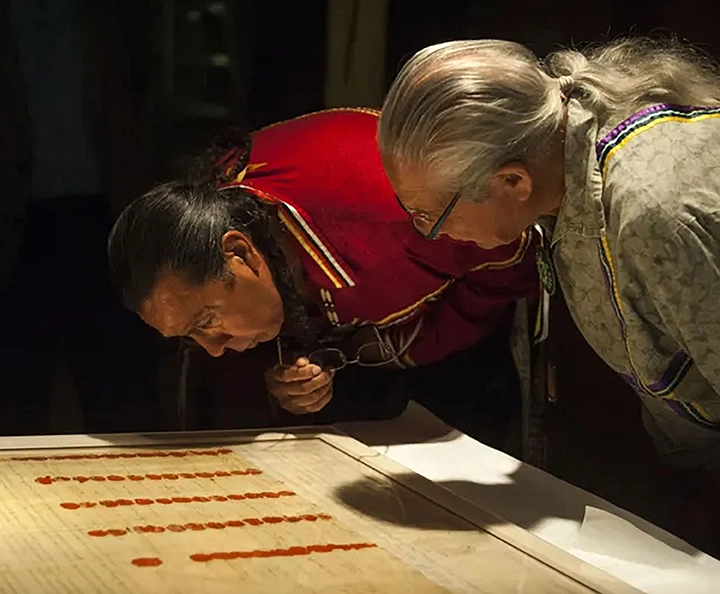
The Treaty, between the Haudenosaunee Confederacy and the United States, is signed by President George Washington and The Six Nations (Iroquois). The exhibition, Nation to Nation: Treaties Between the United States and American Indian Nations, opens Sept. 21, 2014, at the Smithsonian’s National Museum of the American Indian in Washington. AmericanIndian.si.edu. (Kevin Wolf/AP Images for The Smithsonian’s National Museum of the American Indian)